International Collaboration
 时间:2025-11-17
 浏览:14
浏览:14
The GSeisRT software, independently developed by the research team, is currently operational in several international and domestic seismic networks, including the China Earthquake Networks Center (CMONOC), the U.S. EarthScope Network (NOTA), the Chilean National Seismological Center (CSN), GNS Science in New Zealand (GNS), and the Indonesian Geospatial Information Agency (BIG). Its positioning accuracy has been demonstrated to surpass that of leading commercial software such as RTX. During the deployment period, GSeisRT successfully captured seismic events in real time in China, the United States, Mexico, and Indonesia, achieving magnitude estimation errors of approximately 0.1. These results demonstrate the system’s capability for rapid earthquake monitoring and emergency response.
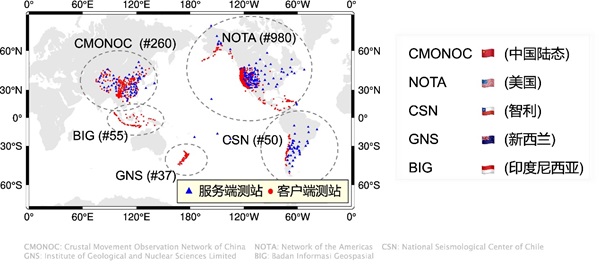
Global Deployment Status of GSeisRT
Centered on the National Natural Science Foundation of China (NSFC) International (Regional) Cooperation and Exchange project, “Research on Consumer-Grade High-Precision BeiDou/GNSS and Its Geoscience Applications”, the research team leverages the advanced experimental platforms of the Wuhan University Satellite Navigation and Positioning Technology Research Center, including outdoor facilities such as vibration tables and strong-motion seismometers, as demonstrated by researcher Wang pai, Associate Professor Guangcai Li and Dr. Xinlei Luo. This effort is integrated with innovative GNSS dynamic displacement monitoring and structural health monitoring techniques developed by the Jacek Paziewski group at the University of Warmia and Mazury in Olsztyn, Poland, as well as open-source tools contributed by Dutch scholars, such as Dr. Lotfi Massarweh’s LAMBDA 4.0 toolbox. Together, these resources establish a multinational, hardware–software integrated research environment. Regular workshops and seminars are held to strengthen academic exchanges on data fusion algorithms, with a particular focus on frontier topics such as optimization of consumer-grade sensors. This framework promotes the practical application and innovation of BeiDou/GNSS in geoscience and lays a solid foundation for sustained China–Poland collaboration in future joint research initiatives, including coordinated experimental campaigns and shared equipment development.
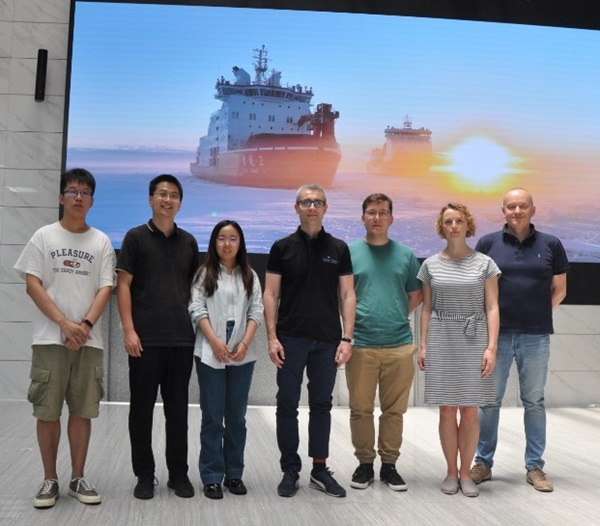
Photograph from the China-Poland Conference
The Wuhan Combination Center (WCC) of the International GNSS Service (IGS), established under the leadership of Researcher Jianghui Geng, head of our research group at the Innovation Academy for Precision Measurement Science and Technology, has been unanimously approved by the IGS Governing Board. WCC is designated, alongside the IGS Analysis Center Coordinator (ACC) led by NASA’s Jet Propulsion Laboratory (JPL), as one of the two IGS global combination centers for precise satellite products. The Wuhan Combination Center is jointly operated by the State Key Laboratory of Precision Geodesy at the Innovation Academy and GNSS Research Center of Wuhan University. It is responsible for the generation of IGS ultra-rapid, rapid, and final orbit/clock/bias products. The combined products produced by WCC will be officially released as IGS products and coordinated with the IGS Analysis Center to jointly promote the continuous development of multi-constellation, multi-frequency, high-precision GNSS products.
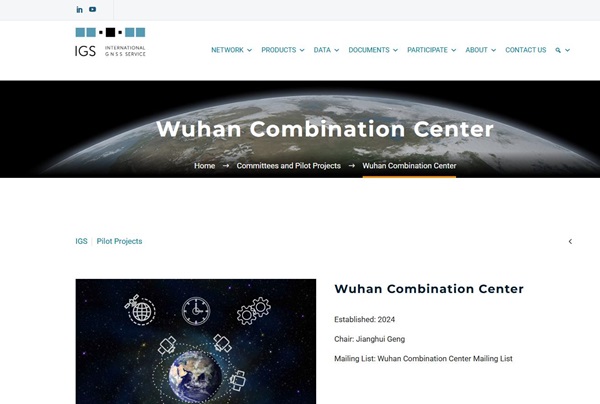
WCC Official Website