Smartphone based high-precision GNSS Symposium Successfully Held at EGU 2026
 时间:2026-05-08
 浏览:14
浏览:14
The symposium on "Smartphone based high-precision GNSS" was successfully convened on the afternoon of May 4, 2026, during the European Geosciences Union (EGU) General Assembly 2026 in Vienna, Austria. The symposium was organized by Professor Jianghui Geng, Director of the State Key Laboratory of Precision Geodesy, in collaboration with international peers. The event focused on cutting-edge technologies in high-precision GNSS positioning of smartphones, featuring a series of insightful academic presentations by scholars from both domestic and international institutions. The symposium attracted a broad audience of experts and researchers engaged in GNSS high-precision positioning and geoscience applications.
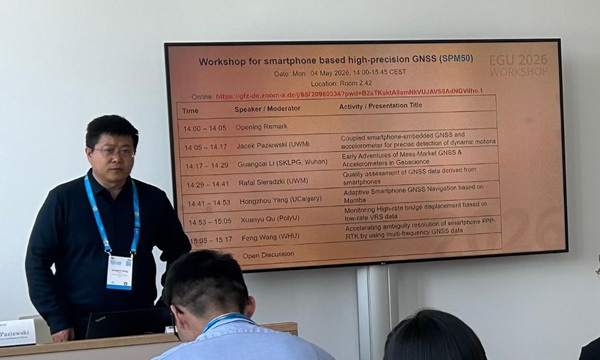
Professor Geng delivered the opening address. He highlighted the rapid advancements in smartphone high-precision GNSS technology, noting that smartphones have evolved from mass-market navigation tools to scientific observation platforms with high-precision positioning potential. He emphasized that the symposium aims to establish a high-level platform for global scholars to exchange ideas on frontier smartphone GNSS technologies and their geoscience applications.
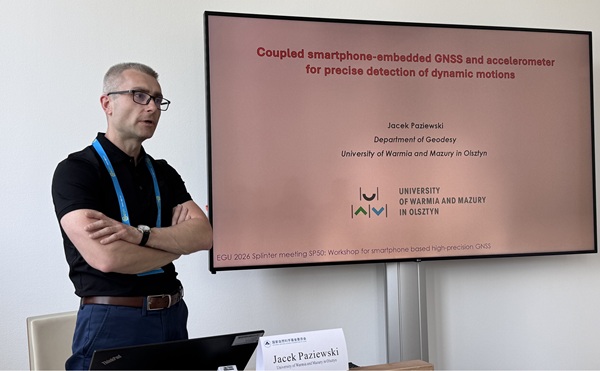
Associate Professor Jacek Paziewski from the University of Warmia and Mazury, Poland, presented a talk titled "Coupled smartphone-embedded GNSS and accelerometer for precise detection of dynamic motions," systematically elaborating on the latest research achievements in deeply coupling smartphone-embedded GNSS and accelerometers for high-precision dynamic displacement monitoring.
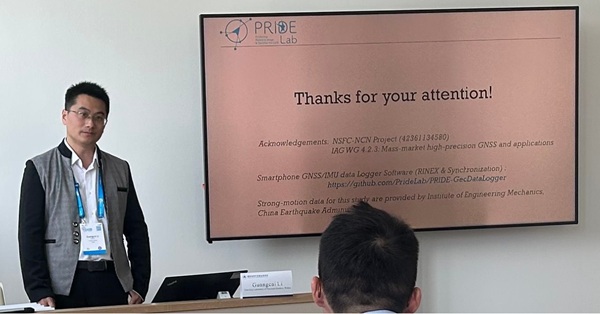
Associate Professor Guangcai Li from the State Key Laboratory of Precision Geodesy and Positioning gave a presentation entitled "Early Adventures of Mass-Market GNSS & Accelerometers in Geoscience," sharing exploratory results on the application of smartphone mass-market GNSS and accelerometers to finite-fault inversion and other geoscience studies.
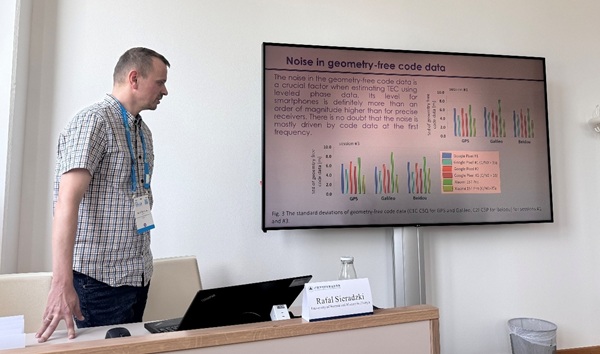
Assistant Professor Rafal Sieradzki, also from the University of Warmia and Mazury, presented a talk on "Quality assessment of GNSS data derived from smartphones," systematically evaluating the multi-constellation GNSS observation data quality of several mainstream Android smartphones and its impact on ionospheric combination observations.
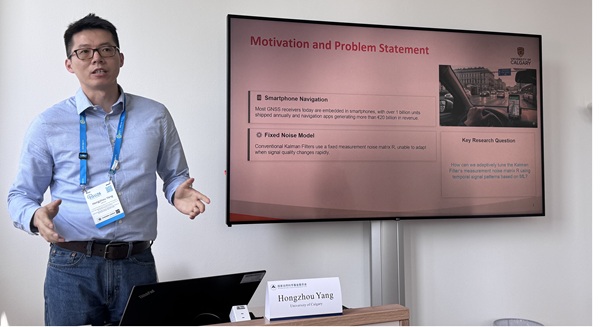
Assistant Professor Hongzhou Yang from the University of Calgary, Canada, delivered a talk titled "Adaptive Smartphone GNSS Navigation based on Mamba," introducing an adaptive smartphone GNSS positioning algorithm based on the novel state-space model Mamba, and presenting an innovative integration of deep learning with traditional navigation algorithms.
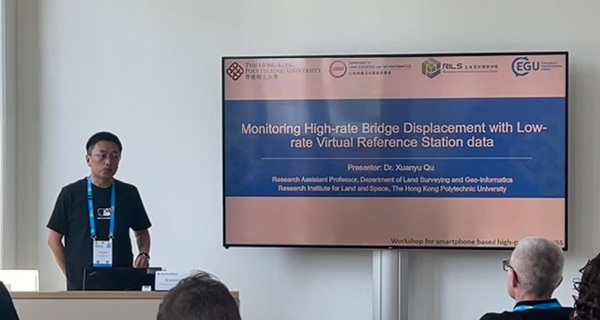
Assistant Professor Xuanyu Qu from The Hong Kong Polytechnic University presented a talk titled "Monitoring High-rate bridge displacement based on low-rate VRS data," showcasing new progress in displacement determination for high-frequency bridge structural health monitoring using low-rate GNSS Virtual Reference Station (VRS) data.

Dr. Feng Wang from Wuhan University gave a presentation titled "Accelerating ambiguity resolution of smartphone PPP-RTK by using multi-frequency GNSS data," demonstrating the latest strategies to accelerate PPP-RTK ambiguity resolution using dual-frequency GNSS data from smartphones.
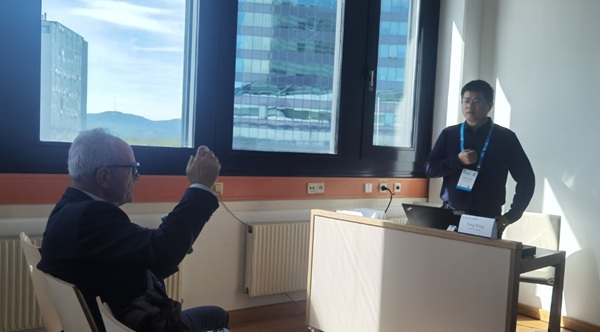
Following the technical presentations, Professor Geng Jianghui moderated an open discussion and proposed two key future directions for the field of high-precision smartphone positioning: first, the optimization and development prospects of smartphone GNSS antennas to enhance observation quality and positioning performance from the hardware perspective; second, the empowerment of artificial intelligence technologies, exploring innovative applications of deep learning algorithms to improve positioning performance in complex environments. Participating experts engaged in a lively discussion on these topics, sharing insights from their respective research experiences on the continuous improvement of mass-market sensor performance, the deep empowerment of AI technologies, and the prospects for geoscience applications.

The successful organization of the "Smartphone based high-precision GNSS" symposium not only provided an important academic exchange platform for experts and scholars worldwide but also further elevated the international influence of China's research in the field of high-precision GNSS positioning. The symposium was supported by the International Cooperation and Exchange Programme of the National Natural Science Foundation of China (Grant No. 42361134580).