Workshop on “IGS GNSS bias and products’ combination” Successfully Held at EGU 2026
 时间:2026-05-12
 浏览:14
浏览:14
On the afternoon of May 7, 2026 (CEST), the workshop on “IGS GNSS bias and products’ combination” was successfully held in Vienna, Austria, during the European Geosciences Union (EGU) General Assembly 2026. Convened by Professor Jianghui Geng, Director of the State Key Laboratory of Precision Geodesy and Positioning, the workshop was co-organized with international peer experts. Conducted in a hybrid format (both in-person and online), the event attracted numerous experts and scholars from the field of high-precision GNSS positioning for in-depth exchanges.
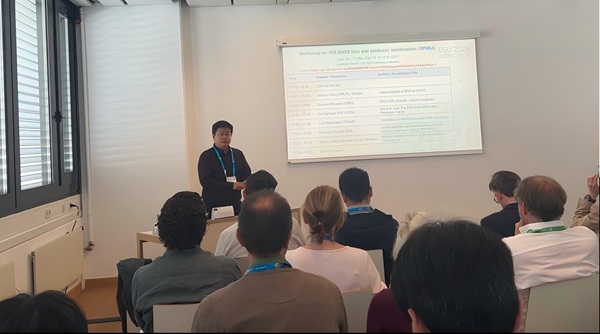
Professor Jianghui Geng delivered the opening remarks. Subsequently, 6 experts and scholars from top global universities and research institutions gave academic presentations centered on the workshop's theme, comprehensively covering the latest frontier advancements in GNSS bias handling and precise satellite products:

Professor Jianghui Geng presented on "Latest progress of IGS BAR and WCC". He detailed the recent progress of the IGS Bias and Ambiguity Resolution (BAR) Committee, established under the leadership of his research group, as well as the Wuhan Combination Center (WCC), one of the two global precise satellite product combination centers. He highlighted the product combination of ultra-rapid satellite orbits and clocks, along with user-end PPP test results, and outlined the roadmap for future work.

Dr. Guilhem Moreaux, head of the CLS Geodesy team associated with the French Space Agency (CNES), presented on "GRG OSB products: status & progress". He introduced the current status of bias products at the CNES/CLS Analysis Center, focusing on modeling and combination methods for Observable-Specific Signal Bias (OSB) products. He analyzed the impact of different modeling strategies on product continuity and stability, and discussed existing challenges and directions for improvement.

Dr. Tim Springer, researcher at the European Space Agency (ESA), presented on "Bye-bye, bias! The ESA Multi-GNSS Bias Reference Frame". He shared insights into ESA's generation and maintenance of long-term differential code bias products covering GPS, Galileo, BeiDou, and QZSS. He also noted that consistent OSB versions and phase bias products are currently under development.

Assistant Professor Lotfi Massarweh from Delft University of Technology (TU Delft) presented on "Uncertainty of clock+phase bias SSR corrections". He explored the uncertainty quantification of satellite clocks and phase biases in SSR products. Through regional network analysis, he examined parameter correlations and user-end impacts, confirmed their enhancement of LEO-PNT positioning performance via simulation experiments, and called for accelerating the standardization of relevant IGS data formats.

Dr. Dimitrios Psychas from the European Space Agency (ESA) presented on "On the real-time joint determination of GNSS clocks and biases in UDUC PPP-RTK". He proposed a full-rank undifferenced and uncombined (UDUC) measurement model suitable for arbitrary-frequency PPP-AR, utilizing a Generalized Kalman filter to achieve real-time joint estimation of satellite clocks and biases.

Assistant Professor Marcus Franz Wareyka-Glaner from TU Wien presented on "Modern Satellite Products: From Application to Performance". From the perspective of PPP users, he discussed key issues in the application of precise satellite products, including day-boundary discontinuities, ORBEX attitude, phase wind-up, and antenna calibrations and variations. He also evaluated the performance of COD, GRG, and WUM precise satellite products, as well as the combined products from IGS and WCC.


Following the presentation session, Dr. Rolf Dach, Chair of the IGS Governing Board, and Dr. Richard Gross, President of the International Association of Geodesy (IAG), delivered concluding remarks. Both leaders spoke highly of the academic value of the workshop and expressed high expectations for the future development of multi-constellation, multi-frequency product combinations.
The successful hosting of the "IGS Biases and Product Combination" workshop not only provided an essential academic exchange platform for global experts and scholars in related fields but also further enhanced China's international influence in the realm of high-precision GNSS positioning research. The workshop was supported by funding from the National Natural Science Foundation of China (Grant No. U25D8020).


On-site and Online Attendance